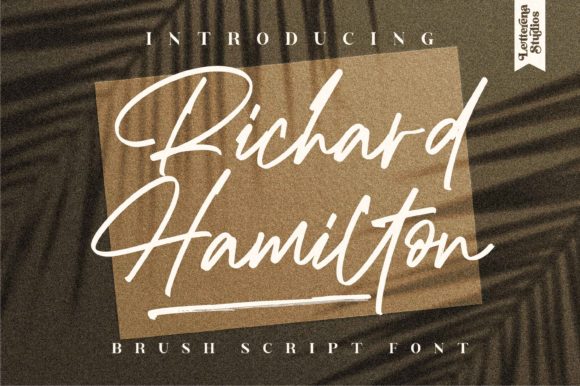
Richard Hamilton Script Handwritten Font for Makers
It was 10 p.m., candle wax still smudged on my desk, and I was tweaking the label for my new lavender-vanilla soy candle—again. The font had to feel warm but intentional, personal but polished. That’s when I opened Richard Hamilton, a modern handwritten font I’d saved for “just the right project.” Within minutes, I typed “Bloom & Ember” across a mockup—and everything clicked. Not just visually, but *emotionally*. This wasn’t just another script font; it was the kind of Script Handwritten typeface that carries quiet confidence, like handwriting from someone who knows exactly what they’re saying.
Richard Hamilton for Candle Labels and Product Packaging
I tested Richard Hamilton on three real packaging formats: kraft sticker labels (1.5" wide), matte-finish box sleeves, and embossed hang tags. On each, the font held its character without looking fragile or overly ornate. Its natural stroke variation—slightly tapered downstrokes, soft entry/exit flourishes—gives handmade products instant authenticity. Because Richard Hamilton is a display-focused Script Handwritten font, it shines best at sizes 14pt and up. At 10pt on a tiny sticker? Legibility dips—not a dealbreaker, but worth noting if your labels pack dense info. For clean pairing, I layered it with Montserrat Light for ingredients and batch numbers. The contrast elevated the whole look: warm personality + quiet professionalism. As a Fonts choice for small-batch makers, it supports brand cohesion without demanding perfect kerning skills.
Richard Hamilton for Wedding Invitations and Elegant Branding
I used Richard Hamilton in a full invitation suite: save-the-date postcards, ceremony programs, and a welcome sign for a rustic-chic barn venue. Its rhythm feels unhurried and human—no robotic symmetry, no aggressive swashes—making it ideal for couples who want elegance without formality. What surprised me most was how well it scaled: crisp at 36pt on a 24"x36" acrylic welcome board, graceful at 18pt on letterpress-printed vellum. Since Richard Hamilton is a modern handwritten font, it avoids the “too cursive” trap—letters connect thoughtfully, not automatically—so names like “Sophie & Elias” flow naturally without tangling. Pair it with a gentle serif like Playfair Display for body text, and you’ve got timeless hierarchy that reads beautifully both in print and on screen. Bonus: the included OpenType features (standard ligatures, contextual alternates) add subtle polish when enabled in design apps like Affinity Designer or Illustrator.
Richard Hamilton for Mugs, Tote Bags, and Shopping Bags
Yes—it works on merchandise. I ran Richard Hamilton through a Cricut Explore Air 2 test cut using premium vinyl on a ceramic mug and a cotton tote. The curves stayed smooth, even at 1.25" height, and the font’s generous x-height kept readability strong from arm’s length. On shopping bags, especially unbleached canvas, Richard Hamilton gave that sought-after “hand-lettered boutique” vibe—no tracing, no digitized wobble. As a Script Handwritten font, it avoids the stiffness of many commercial script options, so phrases like “Carry Joy” or “Made With Love” land with sincerity, not cliché. Just remember: avoid tight tracking or all-caps usage—this Fonts family thrives in sentence case with breathing room between letters. And always check your cutting software preview before sending to machine; some vector simplification can soften delicate terminals.
Richard Hamilton for Printable Wall Art and Digital Downloads
For my latest set of minimalist quote prints (“Breathe,” “Begin Again,” “Tend Your Light”), Richard Hamilton became the anchor. Its warmth softened stark white backgrounds, and its organic weight variation added visual texture without needing extra design elements. As a modern handwritten font, it balances approachability and artistry—ideal for planners, affirmation cards, and nursery wall art where tone matters as much as typography. When prepping files for digital sale, I confirmed the font includes full commercial licensing (check your license file!), which lets me embed it safely in PDF previews and deliver editable Canva templates. One tip: export final JPG/PNGs at 300 DPI with subtle sharpening—the slight ink-like grain in Richard Hamilton’s outlines translates beautifully to print.
Richard Hamilton for Homeware Designs and Seasonal Tags
Last holiday season, I designed linen tea towel prints and wooden ornament tags—all anchored by Richard Hamilton. On textured fabric, its soft edges echoed hand-embroidery; on laser-cut birch, its curves felt intentional, not accidental. It’s especially effective for short, evocative phrases: “Gather,” “Warmth,” “Slow Down.” Because Richard Hamilton is a Script Handwritten font built for impact—not paragraphs—it’s perfect for homeware where messaging is poetic, not procedural. Avoid using it for care instructions or ingredient lists (stick with a clean sans serif there), but lean in hard for titles, monograms, and seasonal signatures. And yes—it holds up in Procreate and Silhouette Studio alike, with consistent spacing and reliable baseline alignment across platforms.
If you’re choosing Fonts that do more than decorate—if you want a Richard Hamilton that helps customers *feel* your intention before they read a single word—this modern handwritten font earns its place in your core design toolkit. It’s not flashy. It’s not fussy. But it’s unmistakably, quietly *yours*.