Chinthya: A Romantic Script Handwritten Font for Elegant Branding
It was 10:47 a.m., and I had just opened a fresh brand board for a new client—a small-batch botanical skincare line launching next spring. The mood board leaned into soft linen textures, dried lavender photography, and muted clay tones. I needed something that whispered “hand-poured,” “thoughtfully made,” and “quietly luxurious.” That’s when I dropped Chinthya onto the logo draft—and paused. Not because it looked flashy or overdesigned, but because it felt *right*: delicate, intentional, and unmistakably human.
Chinthya for Wedding Invitations and Elegant Branding
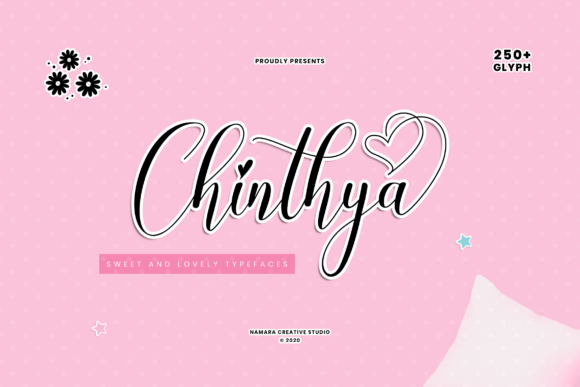
Chinthya is a Script Handwritten font with graceful entry and exit strokes, subtle contrast in stroke weight, and balanced spacing that avoids crowding—even at smaller sizes. In wedding stationery mockups (think letterpress-style save-the-dates or foil-stamped menus), Chinthya delivers romantic warmth without veering into cutesy or overly ornate territory. It’s not fussy, but it’s never plain. I tested it alongside three other premium Fonts in the same category—two with heavier swashes and one with tighter kerning—and Chinthya stood out for its even rhythm and quiet confidence. It doesn’t shout; it invites closer reading.
Chinthya as a Logo Font for Small-Business Identity Systems
For the skincare project, I used Chinthya in the primary wordmark—just the brand name, no tagline. At 36 pt on a business card mockup, it held clarity and charm. At 18 pt on a product label? Still legible, though I’d avoid going smaller than 14 pt for printed applications. As a Script Handwritten logo font, Chinthya works best when paired with a clean, neutral sans serif (I used a light-weight geometric sans for body copy and captions) to ground the elegance in modern simplicity. It’s not a standalone system—it’s a focal point, a signature gesture. Think of it like handwriting your name at the bottom of a thank-you note: personal, memorable, and quietly authoritative.
Chinthya in Packaging Design and Product Labels
On matte-finish apothecary jars and kraft paper pouches, Chinthya added tactile warmth without sacrificing sophistication. Its well-balanced characters meant no awkward gaps between letters—especially important on curved surfaces or narrow label bands. I tested uppercase vs. lowercase usage: lowercase felt more intimate and artisanal (ideal for ingredient lists or scent notes); uppercase worked beautifully for short descriptors like “Lavender + Chamomile” on front-of-pack banners. As a Fonts choice for handmade or slow-lifestyle brands, Chinthya reinforces authenticity—not through roughness, but through considered delicacy. Just be sure to test print output: some ink coverage can soften the fine hairlines, so a high-res PDF proof is non-negotiable before final press runs.
Chinthya for Social Media Graphics and Web Headers
In Instagram carousel headers and website hero sections, Chinthya performed strongly—but only at display sizes. I used it at 48–64 px for H1s and quote overlays, always against ample negative space and soft background tones. It didn’t render crisply below 32 px on mobile, and webfont loading required testing across browsers (it’s available in WOFF2, which helped). As a Script Handwritten typeface, Chinthya is inherently a display font, not a workhorse. Don’t try to use it for navigation menus, blog excerpts, or pricing tables. But for a hero headline like “Hand-Harvested. Slow-Infused.”? Absolutely. It creates pause. It signals care.
Chinthya Font Pairing and Practical Licensing Notes
I paired Chinthya with a warm, low-contrast serif for editorial layouts (think ingredient stories or founder bios) and a crisp, open-counters sans for functional text—never another script. Overpairing scripts dilutes impact; Chinthya shines brightest when it’s the sole voice of personality in a layout. Regarding technical details: Chinthya includes standard ligatures and stylistic alternates (like a flourished ‘&’ and graceful ‘t’ crossbar), but no bold or italic weights—so treat it as a single-purpose Fonts asset. Crucially, check the license before using Chinthya in client work: most versions cover desktop and web use, but extended licenses are required for templates, merchandise, or SaaS platforms. Always verify—you’re protecting both your client and your own practice.
Bottom line? Chinthya isn’t a Swiss Army knife. It’s a finely tuned tool—for moments where emotion, craft, and quiet elegance matter most. If your project lives in the space between handwritten intimacy and polished brand presence, this Script Handwritten font earns its place. Test it early. Use it intentionally. And let it do what it does best: make people lean in, just a little.